I was listening to Raj Shamani's podcast with Dr. Vidita Vaidya, Neuroscientist, TIFR Mumbai, recently,
and one particular segment where Raj questions Dr Vaidya on social media addiction stood out for me.
I think it's somewhere around 1:37.25 to 1.45.
Raj asks a very relatable question: (paraphrasing)
"Why do so many people scroll endlessly through social media, regret it before going to bed, and then repeat the same behavior the next day? What happened to their willpower?"
Dr. Vaidya then goes on to explain that many addictive behaviors, whether social media scrolling, gambling, substance abuse, or even certain everyday compulsions, are driven by the brain's reward circuitry - same underlying circuits involved in food, sex etc - involving dopamine and the basal ganglia.
Raj subsequently asks how one can break away from such entrenched bad habit patterns. To that, her suggestion is that we learn new things, do the hard things, and delay gratification. In her view, novelty and hard work can help disrupt entrenched habit loops.
As I was listening, I couldn't help but be reminded of
Max Benett's "A Brief History of Intelligence", where Bennett discusses a wide array of topics from habit formation, goal-seeking behaviour, to exercising will-power and self-control. (BTW, it's a mind-blowing book that'll introduce you to an enormous range of concepts in
biology, evolution, brain science, and AI. I found it extremely fascinating)
In one of the chapters, Bennett discusses the role of dopamine in affecting reward-seeking behaviours and basal ganglia in solidifying these behaviours into habits. In essence, habits are semi-automated behavioural programs formed through reinforcement (repeated actions), mediated by the basal ganglia and dopamine-based reward signaling. Therefore, when a behaviour becomes a habit, it works on autopilot, in a way, requiring less effort/brain power. (That's when we call something a habit in the first place, right?)
Now, circling back to Raj's question to Dr. Vaidya,
when an addictive behaviour becomes a habit, how does one break away from it?
I mentioned Dr Vaidya's response above. However, Benett's discussion on self-control and willpower offers deeper insights into the above question. While he does not explicitly discuss addiction or breaking away from addictive behaviours, his explanation of the neuroscience of willpower and the role of the neocortex (a specialized region in mammals) and its relationship to basal ganglia and amygdala offers the clue.
Neocortex, basal ganglia, amygdala
The neocortex (prefrontal cortex in particular) functions as the brain's executive leader.It regulates systems such as the basal ganglia, primarily responsible for habit formation, and the amygdala, primarily responsible for processing emotions.
This relationship is similar to that of a boss and his team in a corporate setting. Routine tasks are handled by employees without constant / minimal supervision (amygdala & basal ganglia). However, when an important strategic decision needs to be made, the boss steps in and
provides direction or has the power to change an established process. (Obviously, I am simplifying a lot; but the point is valid)
Now, carefully follow the line of thought. Benett argues that,
Attention, Working Memory, Self-control (often referred to as willpower), Planning are all different applications of the brain and are triggered by neocortical stimulation.The prefrontal cortex -particularly the agranular prefrontal cortex (aPFC), plays a key role in executing all of the above functions in mammals.
Here's the key point: Internal simulation - through imagination, visualization, or manifestation - is a form of neocortical stimulation (activates the aPFC).
What this proves is manifestation plays a key role in self-control and can influence behaviour.
When people talk about manifestation, they often focus on outcomes - manifesting a house, a car, a job, or moving abroad etc.
Many tend to think that if one simply visualizes these outcomes, the universe will somehow conspire to make them happen.
I am not ridiculing those who practice manifestation in the above manner. But it appears to me that the true power of manifestation lies in its ability to direct behaviour not in promising outcomes.
The question now is,
What does one manifest in the context of breaking away from an addictive behaviour? It's logical to manifest an "alternate behaviour", which is perhaps optimised for dopamine.
Here's a para from the book to support my hypothesis,
"How does the aPFC "control" behaviour? The idea presented here is that it doesn't control behaviour per se; it tries to convince the basal ganglia of the right choice by "vicariously showing" it that one choice is better and by filtering what information makes it to the basal ganglia. The aPFC controls behaviour not by telling but showing."
[emphasis added]Pg 218 "How Mammals Control Themselves: Attention, Working Memory, and Self-control"
From a neuroscience perspective, repeated visualisation of a behaviour strengthens the neural representations associated with those behaviours, making it easier for the brain to execute them in real life.
How could this potentially work - my hypothesis
When the cue appears, eliciting a particular bad habit, manifesting the new behavior is the smart thing to do.It does not indicate it'd be possible to execute the new behavior initially, given that the old one has solidified into a habit.
In fact, it's likely that one will fail many times at first. However, by repeatedly manifesting the new behavior, strengthening its neural representation, and gradually associating it with the cue, one can eventually enable the basal ganglia to express the new behavior.
I like to think of it as a vote. Every time the cue appears and you resist executing the old behavior, the brain negatively reinforces that old behavior. Every time you execute the new behavior, the brain positively reinforces it. As the new behavior accumulates enough "votes," it eventually surpasses a certain threshold, making it more likely to be expressed whenever that particular cue appears.
Given that the neocortex regulates systems such as the basal ganglia and the amygdala, I believe manifestation
can help people break away from unhealthy habit patterns and develop healthier ones.
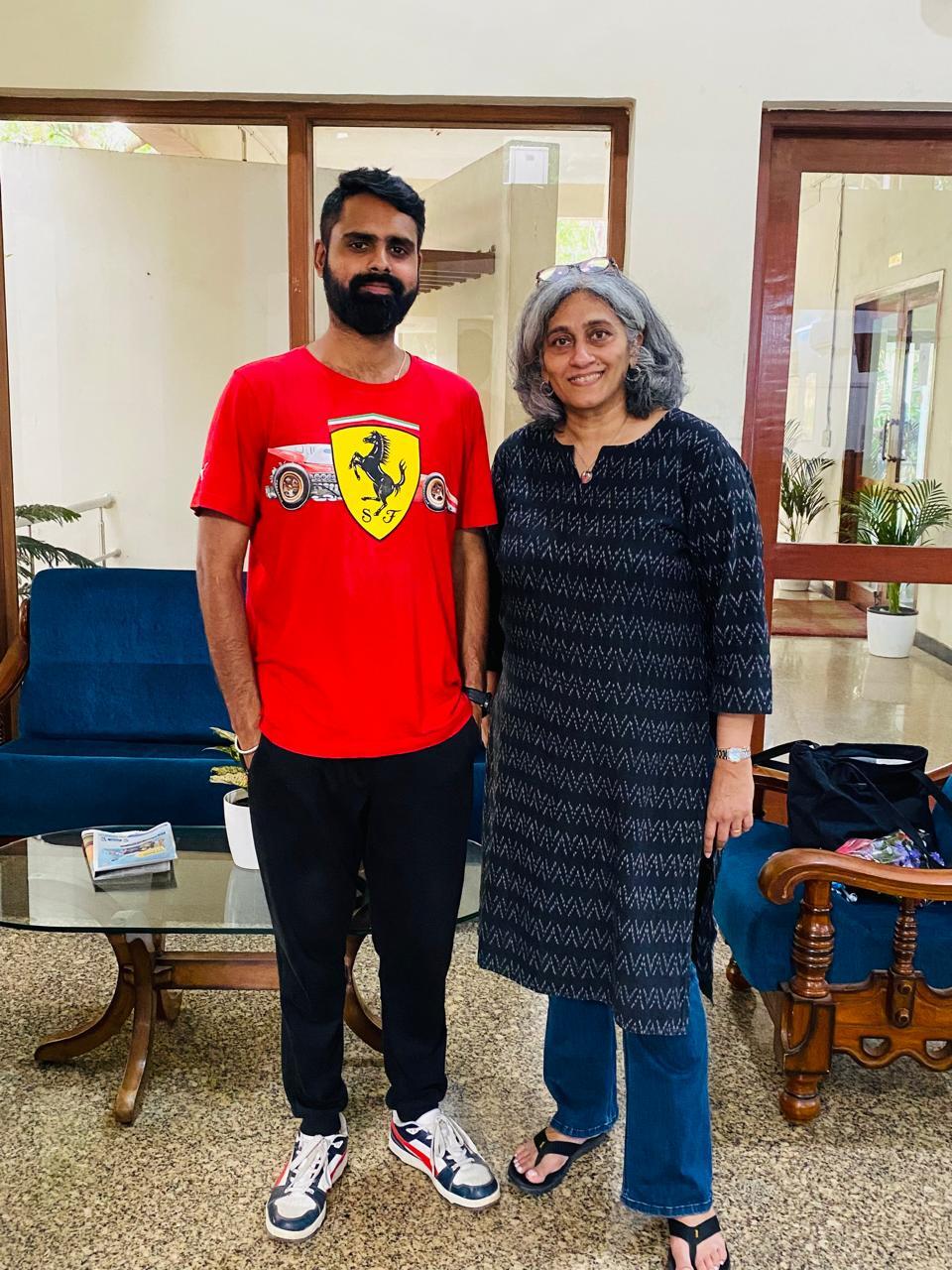
As an aside, here's my picture, taken a few months ago, with Dr. Vidita Vaidya at IIT Madras, post her lecture on Neurobiology. After the session, she was kind enough to interact with me and a bunch of aspirig scientists from IIT Madras on various topics. She encouraged me
to start a podcast and even agreed to appear as a guest :)